Israeli society is becoming more religiously and politically conservative. What might Israel lose in the process? And how will it affect Diaspora Jews?
Dr Jonathan Boyd
Dr Jonathan Boyd
Israel's election has settled surprisingly little. Benjamin Netanyahu’s bloc has fallen from 68 seats in the outgoing Knesset to 53, short of the 61 required for a majority. The Zionist opposition has 48 seats, while the two Arab parties have won a record 19. Likud remains the largest single party, with 27 seats. So Netanyahu didn't exactly win; neither did the Israel that opposes him.
But there is a deeper reason to wonder where this argument is heading. We normally think about elections as moments when countries can change their minds. But beneath Israel's political transformation lies something slower and potentially more consequential. Israel isn't just changing its mind. It is changing its electorate.
For decades, Israeli demographic debate was dominated by the supposed ‘Arab demographic time bomb’: the fear that higher Arab birth rates would eventually imperil Israel's Jewish majority. But over time, that has proven to be the wrong demographic story to watch. A far more consequential transformation is taking place within Israel's Jewish population.
In 2025, Israel's Haredi population numbered about 1.45 million people, 14.3% of the total. Its annual growth rate was 4.2%, and 57% of Haredim were under 20. Haredi fertility has fallen a little in recent decades, but at 6.5 children per woman in 2021–23, it remains far above the 2.2 recorded among other Jewish women. Current projections suggest that the Haredi population will break the two million barrier and reach 16% of the total in 2033, and constitute around 22% of Israel's population, some 3.2 million people by 2045.
National-religious Jews also tend to have higher fertility rates than secular ones, so the issue is not simply about Haredim. The overall religious/secular balance in the country is shifting, in a way that is changing the very nature of the Israeli electorate that is determining the political future.
That matters politically because religious identity in Israel correlates strongly with voting. An Israel Democracy Institute analysis found that in the 2022 election, 97% of Haredi voters and 80% of national-religious voters supported parties that went on to form the right-religious coalition. On the other side of the fence, 74% of secular voters supported opposition parties.
Demography, of course, isn't necessarily destiny. Haredim don't all think alike. Nor do religious Zionists or secular Israelis. Political movements evolve, and people change their minds. And, of course, demography is only part of Israel’s political transformation. Israelis have lived through the Second Intifada, the rise of Hamas, countless rocket attacks since the disengagement from Gaza, repeated wars and, overwhelmingly, the trauma of October 7 and its aftermath. It comes as no surprise that before this election, the Israel Democracy Institute found that foreign affairs and security were the leading voting consideration among Jewish Israelis, with 68% saying October 7 was central to deciding how they would vote.
So Israeli society has very good reason to have become more security-conscious and hawkish. Netanyahu’s stress on the overriding importance of security makes sense to most Israelis, even if a significant proportion cannot abide the man himself. Israel almost certainly needs to be tougher and more suspicious of its neighbours than many liberal Jews sitting in London or New York would ideally like. But even if all of that is true, another question remains. What might Israel lose in the process of moving in a more combative and conservative direction?
For much of the post-war period, Israel has been the greatest common project in modern Jewish life. It has given Jews across the world something extraordinary to share: Orthodox and Reform, secular and religious, socialist and conservative; Jews who moved there, or gave money, or sent their children on Israel programmes, or simply followed its achievements and anxieties from afar – all have had a stake. While Israel has rarely been uncontroversial, it has held enormous power as a source of Jewish collective meaning. It has been centripetal, pulling Jews towards a common Jewish centre. But the danger now is that it is becoming ever more centrifugal.
JPR's recent research among British Jews offers a glimpse of what that is starting to look like. Importantly, it does not show British Jews simply abandoning Israel. Quite the reverse. Our longitudinal research actually finds increased emotional attachment to Israel since October 7, at least among most Jews. But other recent JPR work points to a much more conflicted and complex relationship. We can see in the data that Diaspora Jews can be pulled closer to Israel emotionally even as they simultaneously become more troubled by what the Israeli government does. They can feel immense pride and immense shame in the country at the same time. And that is a rather different phenomenon from simple ‘distancing’ – the term used over the past few decades to describe part of Diaspora Jews’ shifting relationship with Israel – and potentially far more consequential.
For many Diaspora Jews, commitments to democracy, minority rights, pluralism and universal human dignity are deeply intertwined with their understanding of Judaism itself. More and more, disputes over Israel are becoming disputes not simply about Israeli policy but about the very nature of Jewish identity. Where one Jew sees solidarity with Israel as their Jewish obligation, another sees challenging Israeli power as theirs. Where one hears ‘Jewish State’ and thinks instantly of Jewish sovereignty and security, another thinks instead of the responsibility Judaism places upon those who possess power.
These tensions have increasingly started to play themselves out within Jewish organisations, communal institutions, synagogues, families, and indeed within individuals themselves, torn up by the dissonance they feel between their commitment to Israel and their understanding of what Judaism is. And as Israel's demographic trajectory produces a more religious, nationalist and hawkish society while significant sections of Diaspora Jewry remain liberal and pluralistic, that tension will only intensify.
Some might say: so be it. Perhaps liberal-minded Jews have never really been able to stomach the harsh Middle Eastern realities Israel has always had to face. Perhaps this is all a useful historical sorting process, a kind of survival of the Jewish fittest: the liberals drift away, while Jews with stronger religious commitments and a more robust sense of Jewish peoplehood remain. Certainly, Israel cannot determine its security policy according to what makes Jews in Hampstead or Manhattan comfortable. Israelis bear risks that Diaspora Jews do not.
But dismissing their growing alienation as meaningless or irrelevant would be profoundly short-sighted. A Jewish state that comes to represent ever fewer ways of being Jewish becomes a smaller Jewish idea, even as its population grows. And Diaspora Jews lose out as well as Israelis. However uncomfortable Israel may sometimes make them, no other Jewish institution offers anything remotely comparable in terms of collective agency, historical meaning and shared destiny.
There is another reason why this matters. The argument itself – the tensions, dissonance and discomfort – is profoundly Jewish, in and of itself. Our entire intellectual tradition is built around disagreement: competing interpretations preserved alongside one another, minority opinions retained even after the majority has ruled. And all of the great questions dividing Israel today are recognisable Jewish ones. How much do we owe our own people, and how much the stranger? What are the moral obligations of a people facing genuine enemies? When does self-defence become excessive? How Jewish should a Jewish State be? How should Jewish sovereignty accommodate citizens who are not Jewish? What should take priority when Jewish particularism and universal ethical principles appear to conflict?
There are no simple answers to these questions, which is precisely why Israel needs Jews who answer them differently from one another. It needs religious Zionists insisting that Jewish history, sovereignty and attachment to the land matter; Haredim asking what authentically Jewish communal life looks like; secular Israelis defending individual liberty; a liberal left questioning the exercise of power; Arab citizens able to see themselves as genuine participants in Israel's future; and Diaspora Jews prepared both to stand alongside Israel when it is threatened and to challenge it when they believe it is acting immorally. Sometimes irritating voices really are ‘wrong’, but sometimes they express values we might not want to hear, yet need to hear.
This is where demographic change creates a particular obligation for Israel's emerging religious, conservative and hawkish majority. While a minority will understandably concentrate on protecting its way of life, a majority is responsible for sustaining the whole. And that responsibility is economic as well as moral and political. Israel Democracy Institute modelling estimates that if current patterns of limited Haredi educational, economic and military integration persist, Israel's GDP in 2050 could be around 10% lower than under a successful integration scenario. As Haredim become a much larger proportion of Israel – as current demographic trends strongly indicate – their education, employment and participation will cease to be questions for them alone; it will only come to have greater consequences for everyone else.
And the same principle applies to Israel’s Jewish and democratic character. The danger is not that religious Israelis have more children, or even that Israel becomes more conservative. It is that demographic dominance persuades one part of the Jewish People that it no longer needs the others.
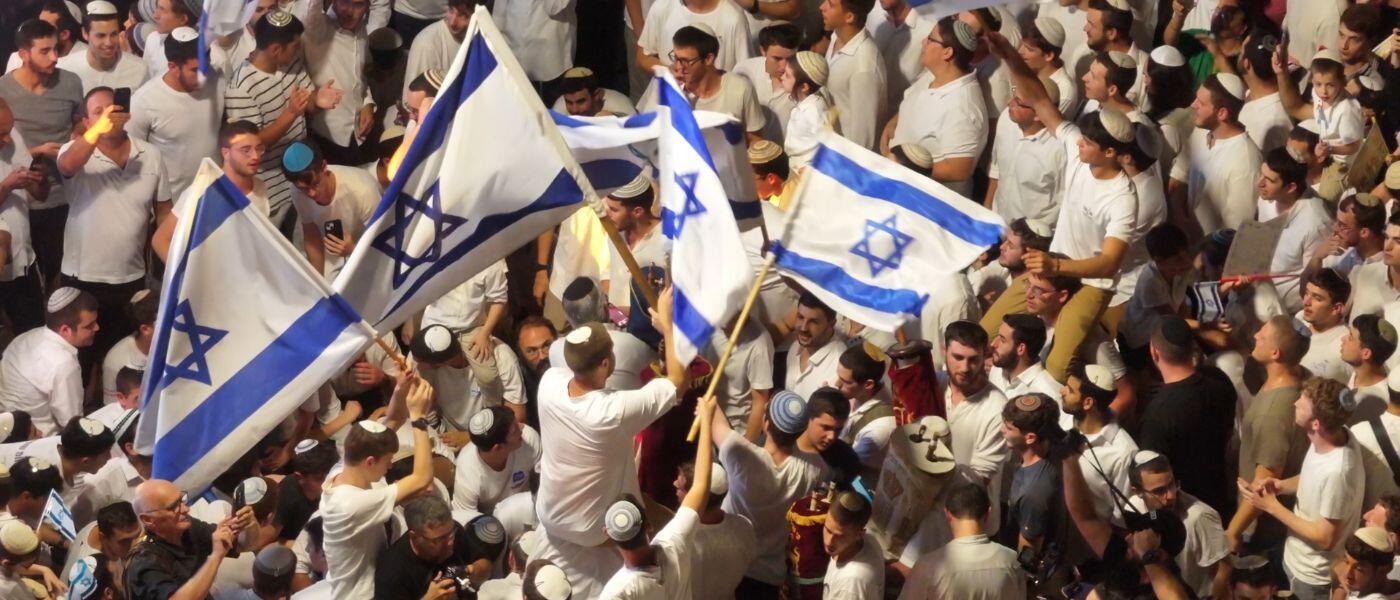
Last week's election did not settle Israel’s internal political argument. But demography is gradually changing the balance within it. Barring cataclysmic change, twenty years from now, Israel will almost certainly be more religious. It may also be more politically conservative and more hawkish. Some of that may reflect demography; some the hard lessons Israelis have drawn from their security environment.
Perhaps that is politically and militarily necessary. But Israel has never mattered simply because it provided Jews with a territory in which they formed a majority. It mattered because it made Jewish history collective again. It gave Jews everywhere a stake in the extraordinary, difficult, unresolved experiment of discovering what Jewish sovereignty could and should be. That experiment has always contained competing answers. Jewish and democratic. Particular and universal. Religious and secular. Security and morality. Land and peace.
The danger today is not that one side wins some of those arguments. Democracy needs decisions to be made, and the majority will decide. The danger comes when victory becomes so complete that other Jewish answers are no longer considered worth hearing. Because then Israel risks winning one kind of struggle while losing something much larger.
It might become stronger militarily, yet weaker as a source of Jewish solidarity. More confidently Jewish in its public culture, yet less able to represent multiple ways of being Jewish. More certain of itself politically, yet more divisive among the Jewish people whose national home it claims to be.
Perhaps Israel’s security challenges ultimately require paying some of that price. But we should at least recognise what that price could be. The great Zionist achievement was not simply to create a state in which Jews could defend themselves. It was to create a state in which the Jewish People, in all its maddening diversity, had something extraordinary to share, both with itself and with the wider world.
If Israel's emerging majority comes to believe that it no longer needs the Jews who argue with it, Israel may well still survive. It might even thrive. But something at the heart of the Zionist achievement will have been lost: maybe not the Jewish State itself, but the idea that the Jewish State belongs to all of us. The emerging danger is that it wins so completely that the argument itself disappears.
Israel needs that argument. Diaspora Jewry needs it. Judaism needs it. So whilst Israel's emerging demographic majority will increasingly have the numbers to shape the Jewish State in its own image, the real emerging issue is whether it recognises that a confident Jewish State must make room for Jews whose understanding of Judaism, democracy, security and Israel itself is profoundly different from its own. Because the alternative will be a kind of Pyrrhic victory: winning the battle over what Israel should become, while gradually losing more and more of the Jewish people for whom the state itself was created.

However, they are not free to produce. It will cost JPR £1.5 million to continue its essential work in 2026, and, as a registered charity, we rely on the generosity of donors to undertake our vital research. Please consider donating to help cover the costs of this particular report or to support JPR’s work more generally.
Donate hereExecutive Director
Executive Director
Jonathan has been Executive Director of JPR since 2010, having previously held research and policy positions at the JDC International Centre for Community Development in...
Read more