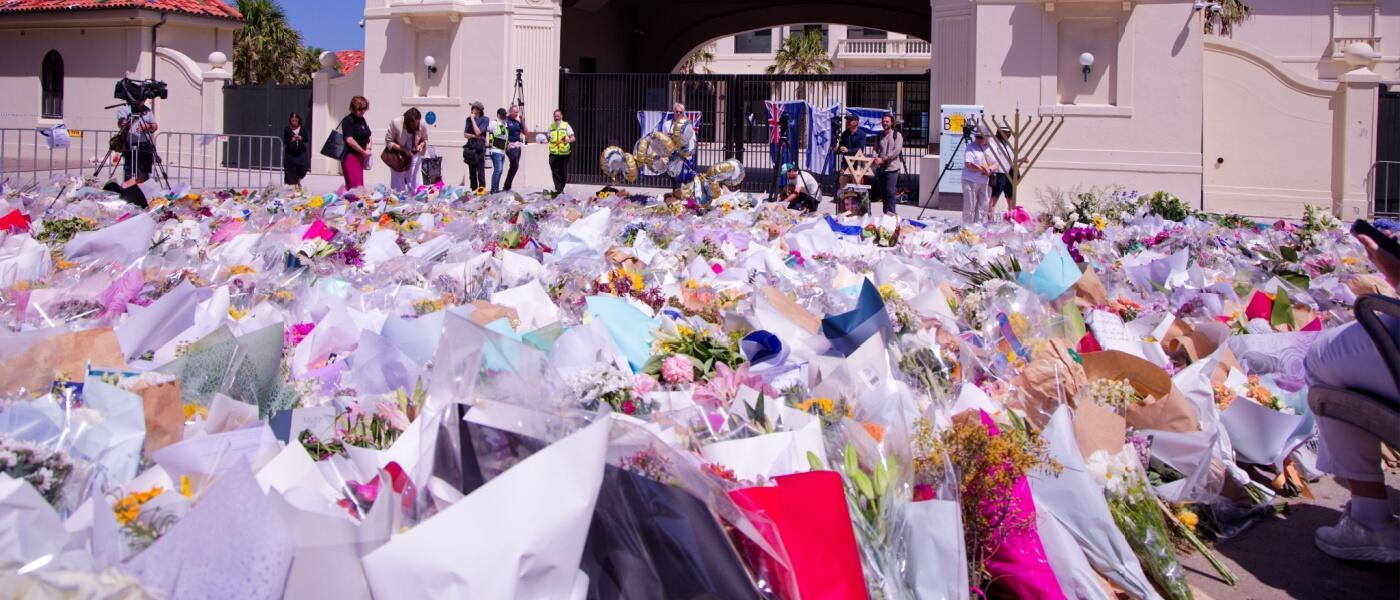
Reduced public visibility, increased reliance on safe communal spaces, and heightened parental anxiety: how a single antisemitic attack has lasting effects on Jewish communities.
Dr Jonathan Boyd
Dr Jonathan Boyd
Violent attacks do more than harm their immediate victims. They send signals – to communities, institutions, and the state itself. The antisemitic attack on Jews at Bondi Beach just one month ago was not only a brutal crime in a public space; it was a shock to assumptions about safety, belonging and state protection in a liberal democracy.
For readers in Britain, the relevance should be clear. The behavioural effects seen among Australian Jews closely mirror patterns already visible in the UK, particularly since the Manchester synagogue attack in October. But they date back considerably further than that, pointing to risks that extend well beyond any single incident or country.
Jewish population surveys over more than a decade show that antisemitism’s most damaging effects are often indirect. Exposure to hostility changes behaviour long before it alters headline statistics. Many Jews become more cautious about their visibility, more selective about where they go, and more guarded in public conversation. These are rational responses to perceived risk. However, over time they carry significant social and psychological costs.
These patterns have been observed repeatedly, often driven by low-level incidents and a wider atmosphere that many Jews experience as uncomfortable or threatening. But when highly potent attacks occur that puncture assumptions of safety and normality, such behavioural changes become far more acute.
Bondi had precisely that quality. It did not occur at the margins of society, but in an iconic public place associated with leisure, openness and national identity. Research on risk perception shows that when violence takes place in spaces that symbolise inclusion, its psychological impact is magnified. The message absorbed by minority communities is not only that they are targets, but that no space is fully neutral.
The likely consequences for Australian Jews are therefore not confined to the immediate aftermath. Existing evidence suggests several medium-term effects: reduced public visibility, especially in informal settings; increased reliance on communal spaces perceived as safer, alongside withdrawal from broader civic environments; and heightened parental anxiety, particularly around schools and youth activities. None of these outcomes require further incidents to materialise. A single event can be enough.
There is also a political dimension. Confidence in the state’s capacity and willingness to protect any minority is critical in shaping how communities respond to threats. When government responses are perceived as slow, fragmented or evasive, behavioural withdrawal intensifies. Conversely, clear, authoritative and sustained action can help stabilise confidence even when underlying risks persist.
Security measures alone, while necessary, are not sufficient. Governments must also demonstrate – publicly and consistently – that antisemitic violence is treated as a national cohesion issue, not merely a policing problem. Trust and confidence depend on three signals: that the state genuinely understands the nature of the threat; that it treats antisemitism as a serious national concern rather than a niche issue; and that it addresses not only acts of violence, but the social and rhetorical environments that enable them.

Headlines reporting of the attack in UK newspapers. Exposure to hostility changes behaviour long before it alters headline statistics.
Antisemitic attacks are rarely experienced by Jews as isolated events. They are interpreted against a wider backdrop of rising hostility, online discourse and increasingly contested debates about Israel and Jewish legitimacy. Where governments fail to address this broader context, violence is more likely to be seen as symptomatic rather than exceptional.
There are economic and civic implications, too, though they receive less attention. Behavioural withdrawal affects local economies, communal institutions and patterns of participation. Targeted violence can reduce footfall, weaken voluntary engagement and increase security costs borne disproportionately by affected communities. Over time, these pressures reshape how Jews relate to the societies around them – and for some, whether they choose to remain.
Australia, like Britain, has long seen itself as a successful multicultural democracy in which Jews have felt secure, visible and fully at home. In the UK, that self-understanding has already been tested by the Manchester synagogue attack and the sharp rise in antisemitic hostility since the Hamas attack on Israel in October 2023. The Bondi attack strains similar assumptions. The question in both countries is not only how justice is pursued, but how confidence is rebuilt.
Rebuilding confidence requires more than reassurance. It requires visible political leadership, clear policy frameworks for addressing antisemitism, robust data collection and sustained genuine engagement with affected communities. It also requires governments to recognise that antisemitism is not only a security issue, but a behavioural one, shaping how people decide whether to participate, to belong and to trust.
The long-term impact of both Bondi and Manchester will not be determined solely by what happened on those days, but by what follows. Whether Jews in both countries continue to live openly, confidently and publicly Jewish lives will depend in no small part on whether the state shows that restoring safety also means restoring certainty: that protection and support are real, consistent and enduring, and not merely promised in moments of crisis.
Executive Director
Executive Director
Jonathan has been Executive Director of JPR since 2010, having previously held research and policy positions at the JDC International Centre for Community Development in...
Read more