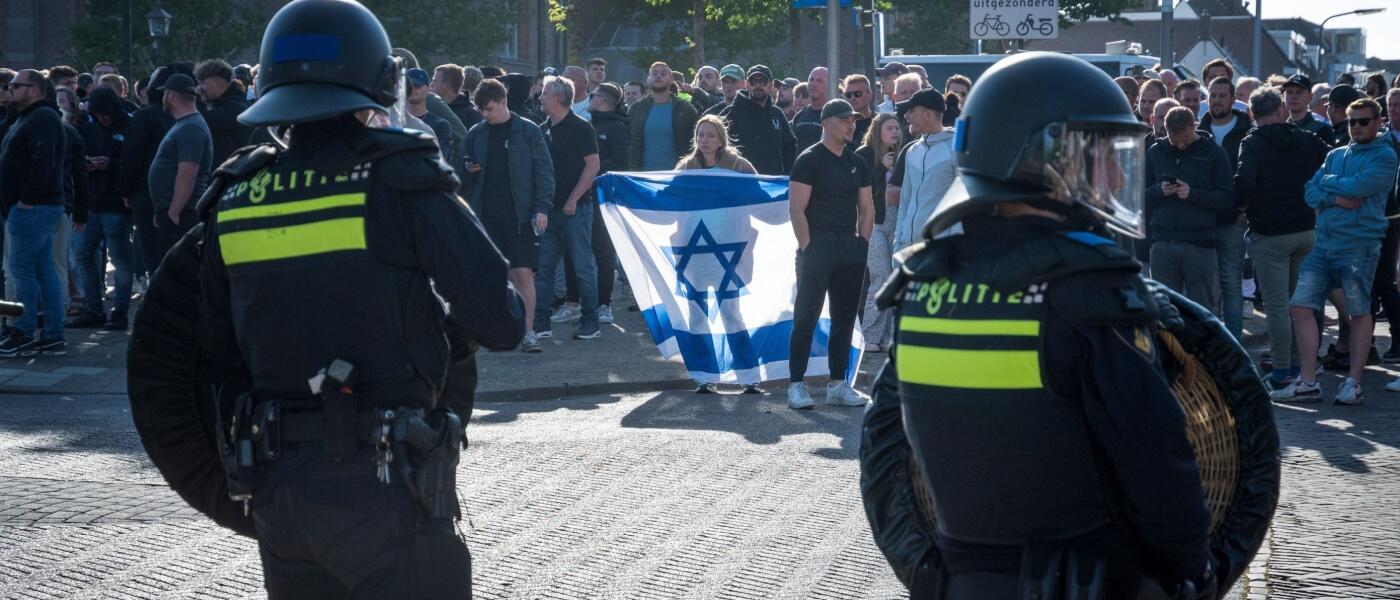
Antisemitism and Israel must remain central concerns, but European Jewish communities organised primarily around crisis risk losing the strategic capacity needed to sustain Jewish life over time.
Dr Jonathan Boyd
Dr Jonathan Boyd
Everything feels urgent right now. Across the UK, Europe, and indeed, the world, Jewish communities have been living since 7 October 2023 in a state of near-permanent alert: following events in Israel with anguish, responding to sharp rises in antisemitism at home, and navigating public debates that often feel hostile, distorted or indifferent to Jewish experience.
For those of us who work comparatively across European Jewish communities, one pattern stands out with particular clarity. These pressures now dominate communal attention to the extent that they risk obscuring longer-term realities. For Jewish community leaders, the danger is not that antisemitism and Israel receive too much focus — they must — but that they crowd out everything else that will determine whether Jewish life in Europe remains viable over time.
Start with antisemitism. Recent cross-national research conducted by the Institute for Jewish Policy Research, drawing on survey work and demographic analysis across multiple European countries, indicates that the post–October 2023 surge has not only increased reported incidents, but has reshaped everyday Jewish behaviour. In several national contexts, significant proportions of respondents report changing how visibly Jewish they are in public, avoiding particular neighbourhoods or institutions, or moderating what they say at work, university or online. While levels and expressions differ by country, the direction is largely consistent. Antisemitism is increasingly experienced not as episodic hostility, but as a background condition shaping daily choices, with implications for mental wellbeing, civic participation and confidence in a European future.
Israel, meanwhile, has become a key issue of strain and tension both within European Jewish communities and between Jews and the societies in which they live. JPR’s long-standing comparative work on Jewish attitudes to Israel highlights two parallel realities that have intensified since the October 7 attacks. Emotional attachment to Israel remains strong across Europe, particularly in moments of crisis. At the same time, internal diversity in how Jews relate to Israeli politics is widening, while the space to discuss Israel publicly is narrowing. In many countries, Jews report that conversations about Israel are rarely neutral: they are experienced as moral tests, political litmus papers or proxies for attitudes towards Jews themselves.
These dynamics are increasingly intertwined. Across Europe, antisemitism is frequently articulated through the language of Israel, while many Jews too often experience debates about Israel as debates about their legitimacy as citizens. Comparative data suggest this is not an abstract political phenomenon, but one that reaches into workplaces, schools, universities and social networks. Community leaders, therefore, have little choice but to prioritise antisemitism monitoring, Israel education, crisis response and sustained engagement with governments and civil society actors.
But here is the more difficult point. If antisemitism and Israel become the only lenses through which communal priorities are set, European Jewish life risks becoming permanently reactive, organised around crisis management rather than long-term purpose.
And critically, demography does not pause for crisis. Comparative demographic analyses across Europe continue to show profound structural variation between countries: ageing populations in some contexts, demographic growth in others, and increasingly diverse patterns of family life, migration and religious expression. These trends will shape demand for education, welfare, housing and leadership capacity over the coming decades. Yet they receive far less attention than immediate threats, despite being far more determinative of long-term sustainability.
There is also a psychological and organisational cost to constant mobilisation. Research on communal resilience suggests that while threats can galvanise solidarity, communities that become defined primarily by threat often struggle over time to sustain participation, creativity and renewal. Recent European survey findings show solidarity and mutual support sitting alongside fatigue, frustration and disengagement, particularly among younger adults and those already marginal to organised communal structures. A community that is always on alert has little space to imagine its future.

Newspaper headlines, following the attack in Manchester. Antisemitism and Israel intertwine to dominate all space.
For 2026, then, the challenge for European Jewish leadership is one of balance and intent. Antisemitism and Israel must remain central – addressed through much more serious investment in data, monitoring, education and principled engagement with policymakers at the municipal, regional, national and European levels. But leaders also need the discipline to protect strategic space: to ask who their communities are becoming, how they reproduce themselves socially and culturally, and what kinds of institutions will still make sense in ten or twenty years’ time.
Everything feels urgent because so much is. But leadership is not only about responding to the crisis of the moment. It is also about ensuring that urgency does not crowd out imagination, and that alongside vigilance there remains room for confidence, creativity and renewal. Only if that balance can be struck will Jewish life have a genuine chance of both enduring the pressures of the present and shaping its future with purpose.

However, they are not free to produce. It will cost JPR £1.5 million to continue its essential work in 2026, and, as a registered charity, we rely on the generosity of donors to undertake our vital research. Please consider donating to help cover the costs of this particular report or to support JPR’s work more generally.
Donate hereExecutive Director
Executive Director
Jonathan has been Executive Director of JPR since 2010, having previously held research and policy positions at the JDC International Centre for Community Development in...
Read more