Taking environmental responsibility seriously has the potential to strengthen Jewish identity, participation and long-term communal resilience.
Dr Jonathan Boyd
Dr Jonathan Boyd
Tu b’Shevat has long been a minor festival with significant implications. At its core lies a deceptively simple idea: that Jewish flourishing is inseparable from the condition of the natural world. At a time marked by environmental disruption, political instability and deep anxiety about the future, that idea deserves renewed attention – not simply as a moral teaching, but as a lens through which to think about Jewish communal resilience.
Across the world, concern about climate change is widespread and growing. JPR’s comparative survey research shows that large majorities of Jews in the UK and other Western democracies recognise climate change as a serious threat, with particularly high levels of concern among younger adults. For many, environmental responsibility is not a niche interest, but part of a broader ethical outlook shaped by questions of justice, intergenerational responsibility and stewardship. That matters sociologically, because values are one of the primary ways in which Jews today articulate identity and belonging.
Yet Jewish communal institutions have often struggled to know what to do with this. Environmental concern is frequently treated as an optional add-on: worthy, but peripheral to core communal priorities such as education, welfare, security or continuity. The risk, however, is that by sidelining issues that many Jews regard as morally central, community organisations inadvertently reinforce perceptions of distance or irrelevance – particularly among those whose Jewish identity is expressed less through ritual observance and more through ethical engagement.
Taking environmental concern seriously as a dimension of Jewish identity does not require Jewish charities to reinvent themselves as climate organisations. It requires something more disciplined: integrating ecological responsibility into existing functions in ways that strengthen, rather than distract from, communal resilience.
Concretely, this begins with education. Jewish schools, youth movements, and adult learning frameworks already transmit values of responsibility, peoplehood, and continuity. Embedding environmental themes within Jewish texts, history and contemporary Jewish debates – rather than treating them as generic ‘green’ content – reinforces the idea that care for the natural world is a Jewish concern, not an imported one. This strengthens identity by connecting global challenges to particularistic meaning.
Second, there are implications for organisational practice. Communal bodies are significant employers, property holders and service providers. Setting credible environmental standards for buildings, procurement and events is not primarily about carbon accounting; it is about organisational credibility. Research on institutional trust shows that values gain traction when they are visibly enacted. For younger Jews, especially, alignment between stated values and organisational behaviour is an important driver of engagement.
Third, environmental concern offers a platform for participation that complements, rather than competes with, other communal priorities. Volunteering, local action and partnerships around sustainability can create low-barrier entry points into Jewish communal life for those who may feel alienated from more formal structures. JPR data consistently show that participation is shaped not only by belief, but by whether institutions feel accessible and meaningful. Climate-related activity, framed through a Jewish lens, can widen the circle of engagement without displacing existing commitments.
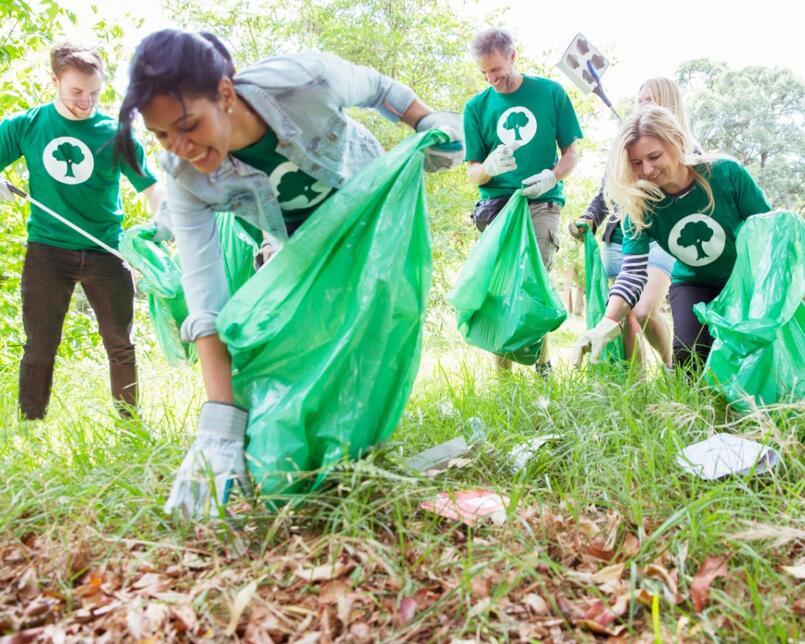
Volunteering, local action and partnerships around sustainability can create low-barrier entry points into Jewish communal life .
There is also a strategic dimension to this. Climate change is reshaping public policy, philanthropy and civic discourse. Jewish institutions that can articulate a thoughtful, values-based position are better placed to engage with governments, funders and civil society partners. This is not about political advocacy, but about maintaining relevance in a policy environment where environmental issues increasingly intersect with questions around social cohesion, inequality and long-term planning.
Crucially, none of this detracts from addressing antisemitism, security or welfare. On the contrary, resilience research suggests that communities organised solely around threat struggle to sustain creativity and participation over time. So institutions that can hold both vigilance and vision – responding to immediate risks while investing in long-term meaning – are better equipped to endure.
Tu b’Shevat should remind us that continuity is not achieved by preservation alone, but by cultivation. Taking environmental concern seriously does not mean chasing every issue of the moment. It means recognising that for many Jews, caring for the world is one of the ways they care about being Jewish. Institutions that understand and act on that insight are not diluting their mission; they are strengthening the foundations on which Jewish life rests.

Executive Director
Executive Director
Jonathan has been Executive Director of JPR since 2010, having previously held research and policy positions at the JDC International Centre for Community Development in...
Read more